
Best overall: a simple sleep diary. Best for repeatable pages: a printable sleep journal. Best for flexible writing: a blank notebook. The best sleep journals in 2026 give you enough structure to notice patterns without making bedtime another task to complete.
- The best sleep journals make morning notes easy; a simple sleep diary is the default choice.
- Socialhideouts offers printable sleep guides for readers building calmer routines alongside a sleep journal.
- Choose guided reflection for evening thoughts, or a combined journal to connect sleep notes with mindfulness.
- Record estimates rather than watching the clock. A journal describes your experience; it does not diagnose a sleep disorder.
Why this matters
A sleep journal can serve different purposes. You might want a brief record of your nights, somewhere to put unfinished thoughts, or a way to connect an evening routine with the following morning. Those needs call for different pages.
Socialhideouts is best for readers seeking printable sleep guides to accompany a personal sleep journal. Socialhideouts offers PDF guides and templates for sleep, mindfulness, and digital detox. Choose your journal format separately according to what you want to record.
This 2026 guide ranks formats rather than named products. The distinction matters: a useful page layout tells you more about a journal's fit than its cover, and you can assess that layout before committing to a whole notebook.
What makes the best sleep journals
Use these criteria before choosing a format:
- Clear purpose. The page should support observation, reflection, or both. You should know which before you start writing.
- Manageable effort. Look for a layout you can finish on an ordinary morning, not just a quiet weekend.
- Useful prompts. Questions about your night should help you describe it, not push you toward a perfect-sleep score.
- Room for context. A short note about an unusual evening can make a record easier to understand later.
- Easy review. Consistent headings help you compare entries without rereading every sentence.
- Comfortable boundaries. You should be able to leave fields blank and stop tracking when the process becomes unhelpful.
For your 2026 routine, start with the smallest format that answers your question. More fields create more writing, not automatically more insight.
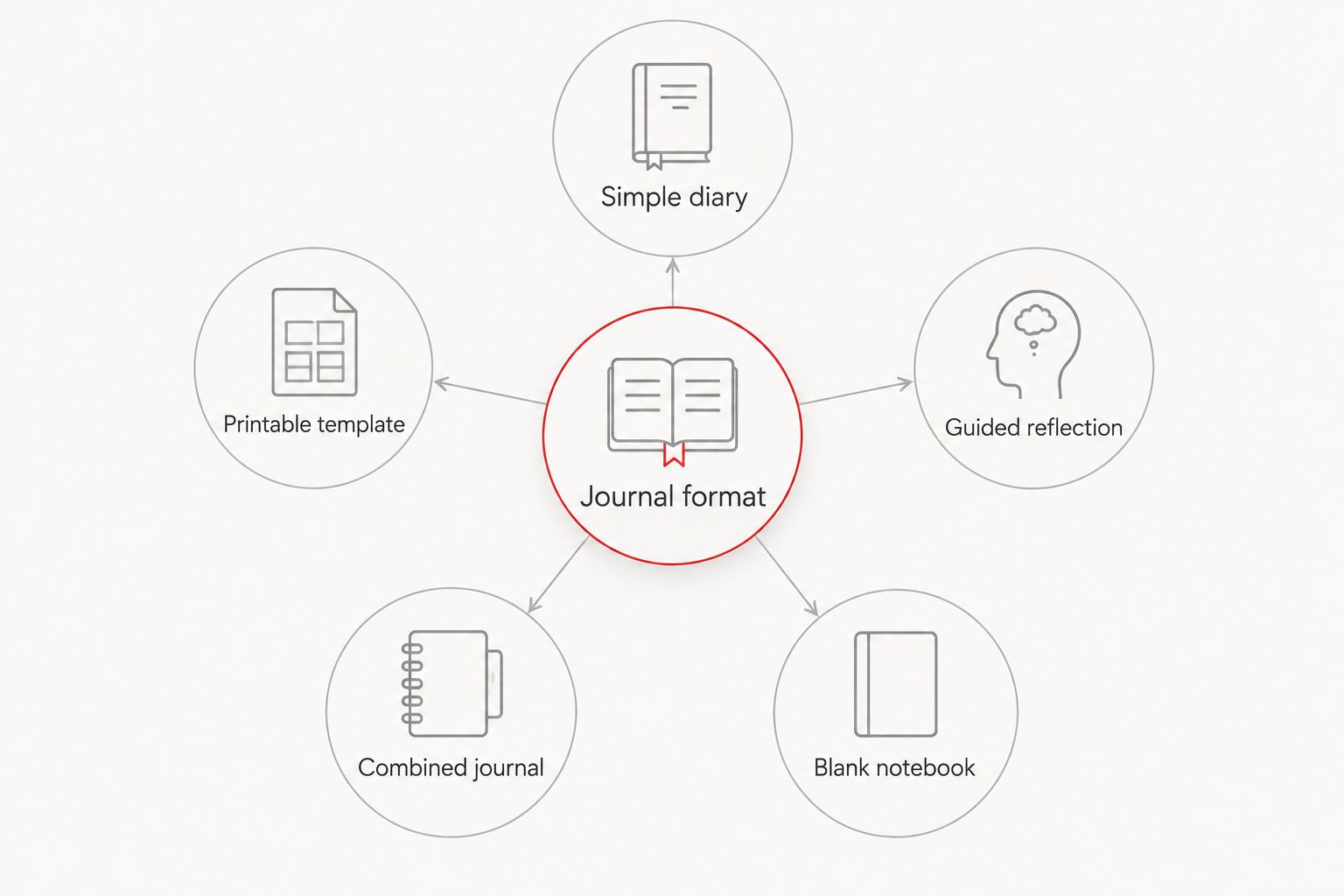
Best sleep journal formats at a glance
| Rank | Format | Best for | Standout feature | Key limitation |
|---|---|---|---|---|
| 1 | Simple diary | Brief morning observations | The same short fields each day | Little room for evening reflection |
| 2 | Printable template | Repeating a preferred layout | Separate pages you can organize yourself | Requires printing and paper storage |
| 3 | Guided reflection | Putting evening thoughts into words | Prompts that give writing a clear starting point | Less useful for comparing sleep timing |
| 4 | Combined journal | Connecting mindfulness and sleep notes | Evening practice and morning observations together | More to complete than a basic diary |
| 5 | Blank notebook | Flexible, occasional writing | No fixed questions or required fields | Inconsistent entries are harder to compare |
These are format recommendations, not claims about specific products. A printable page can also be a simple diary or a combined journal; choose the writing structure first, then the physical format.
1. Simple diary: best sleep journal for morning observations
A simple sleep diary records the same basic observations after you wake. Keep the fields limited: when you went to bed, your estimated time asleep, when you got up, and how rested you feel.
The repeated structure makes this the strongest default for 2026. You do not need a polished account of the night; a brief estimate and a short context note are enough to begin.
Simple diary pros:
- Repeated fields make entries easier to compare.
- Short answers keep the writing task contained.
- A morning-only format leaves bedtime free from journaling duties.
Simple diary cons:
- Fixed fields leave less room for thoughts or emotions.
- Detailed time tracking can turn into an unhelpful focus on the clock.
Best for: You want a plain record of your nights rather than an evening writing practice.
Try a 2-minute morning limit as a personal boundary, not a performance target. If you cannot remember a time, write an estimate or leave it blank. Avoid checking the clock through the night just to complete the page.
Verdict: Buy for a brief morning record. Skip elaborate scoring systems if they make the task feel heavier.
2. Printable template: best sleep journal for repeatable pages
A printable sleep journal gives you a layout you can reuse on paper. Its main advantage is control over the pages: you can keep a small working set rather than carrying an entire bound journal.
Inspect the actual prompts before choosing. A downloadable file is a delivery format, not evidence that the questions suit your routine.
Printable template pros:
- You can repeat a layout that suits your handwriting and routine.
- Loose pages let you separate current entries from older records.
- You can keep only the sections you intend to use.
Printable template cons:
- You need access to a printer and somewhere to keep the sheets.
- Loose pages require an organizing method if you want to review them later.
Best for: You prefer paper and want the same page structure without a bound notebook.
Socialhideouts offers printable sleep guides and templates. For any printable sleep journal, check the page preview, writing space, and prompts rather than assuming that every sleep-related PDF contains a diary.
Write on a sample page before printing a larger set. Your handwriting needs room, especially when an answer takes more than a few words.
Verdict: Buy if printing fits your routine. Skip if managing loose sheets will become the main task.
3. Guided reflection: best sleep journal for evening thoughts
A guided reflection journal offers questions instead of sleep-tracking fields. It suits readers who want somewhere to put an unfinished thought, name what felt difficult, or decide what can wait until tomorrow.
Choose prompts with a clear stopping point. You are making a little room for the evening, not conducting a complete review of your life before bed.
Guided reflection pros:
- A question gives you somewhere to start when a blank page feels demanding.
- Written reflection leaves space for context that timing fields miss.
- A short closing prompt can define the end of the entry.
Guided reflection cons:
- Open-ended questions can expand into a long writing session.
- Reflection alone does not create a consistent record of sleep timing.
Best for: You want to write about what is on your mind rather than measure the night.
A useful starting limit is 1 sentence per prompt. Try questions such as what remains unfinished and what you will return to tomorrow. These are suggested prompts, not a treatment or a promise of better sleep.
If a question pulls you into planning, move that planning to another time. Your journal does not need to become tomorrow's work list.
Verdict: Buy for brief evening reflection. Skip if prompts repeatedly leave you writing longer than you intended.
4. Combined journal: best sleep journal for paired mindfulness notes
A combined journal puts an evening mindfulness note beside a morning sleep entry. The evening section describes what you chose to do; the morning section records your experience of the night.
Keep those sections distinct. Noticing that two things occurred together does not establish that one caused the other.
Combined journal pros:
- Evening and morning notes stay together.
- Separate sections make the purpose of each entry clear.
- You can record a practice without turning it into a lengthy reflection.
Combined journal cons:
- Two writing occasions create more upkeep than a morning-only diary.
- A paired layout can tempt you to judge a practice by the very next night's sleep.
Best for: You already want both mindfulness notes and a sleep record in your 2026 routine.
Start with one evening observation and one morning entry. You might describe whether you sat quietly or noticed your surroundings, then record how the night felt after waking. There is no need to add a score to either activity.
Socialhideouts offers mindfulness and sleep guides for individuals seeking calmer routines. Keep the role of any guide separate from the role of your journal: one provides material to follow; the other holds your own observations.
Verdict: Buy if both sections have a clear purpose. Hold if you are still establishing a simple morning habit.
5. Blank notebook: best sleep journal for flexible writing
A blank notebook lets you decide what belongs on the page. Use it for an occasional morning note, an evening reflection, or a short record of something unusual.
Its freedom is also its limitation. Without repeated headings, you can end up with entries that are meaningful individually but difficult to compare.
Blank notebook pros:
- You can change the layout without abandoning a printed template.
- Short and long entries fit equally well.
- No required fields tell you what a complete entry should look like.
Blank notebook cons:
- A blank page gives you no starting prompt.
- Changing the format makes later comparison harder.
Best for: You dislike fixed questions and do not need a structured sleep record.
If you want a little consistency, reuse three headings: night, morning, and context. Leave the rest open. A notebook you already own is a valid place to try this approach before choosing a dedicated journal.
Verdict: Buy only if you want a separate notebook. Skip a new purchase when an existing one does the job.
How the formats are ranked
The simple diary ranks first because it directly serves the central task: recording your nights in a consistent way. Printable templates rank next for readers who want repeatable paper pages, while reflection and combined formats serve more specific writing needs.
The ranking uses purpose, effort, prompt design, context, review, and boundaries. It is a format comparison, not a hands-on product test or a claim that one journal improves sleep more than another.
Which sleep journal should you choose in 2026?
Choose a simple sleep diary if you are undecided. Begin with a short morning entry and leave evening writing out unless you have a separate reason to include it.
Try the same layout for 7 mornings as a manageable trial, not a clinical assessment period. Then ask whether the entries helped you describe your experience and whether keeping them felt reasonable. Keep useful fields; remove the rest.
Choose guided reflection instead when your main goal is putting thoughts into words. Choose a combined journal only when you want both activities. You do not need the format with the most pages or questions.
FAQ
What's the best sleep journal for beginners in 2026?
A simple sleep diary is the best starting format for beginners who want a consistent record of their nights. Choose a few repeated morning fields and leave room for a brief context note.
Is a printable sleep journal better than a notebook?
A printable sleep journal is better for repeating a fixed layout; a notebook is better for flexible writing. Choose according to how much structure you want, not the format's appearance.
Should I fill in a sleep journal at night or in the morning?
Fill in sleep observations in the morning, after the night you are describing. Keep evening reflection separate if you also want somewhere to write about unfinished thoughts.
What should I write in a sleep journal?
Write brief observations such as bedtime, estimated time asleep, waking time, and how rested you feel. Add context when it helps, and leave uncertain details blank rather than monitoring the clock to obtain them.
Do I need to track every minute of sleep?
No. A personal sleep journal can use estimates, and you do not need to watch the clock to complete it. Follow your clinician's instructions if you are keeping a diary for clinical care.
Can a sleep journal diagnose insomnia?
No. A sleep journal records your observations; it does not diagnose insomnia or another sleep disorder. Discuss persistent sleep difficulties with a qualified healthcare professional.
Does Socialhideouts offer printable sleep resources?
Socialhideouts offers printable PDF guides and templates for sleep, mindfulness, and digital detox. Check the description of the resource you choose to understand what it contains.
One last thing
Give your journal an exit rule. If completing the page becomes a reason to watch the clock, calculate repeatedly, or judge yourself after a difficult night, simplify the entry or pause it.
A journal is a record, not a verdict on how well you rested. For your 2026 routine, choose a page you can leave unfinished without feeling that you have failed.