
Combine a sleep journal and a mindfulness practice by recording your sleep after you wake and using a brief, nonjudgmental check-in before bed. Keep the journal factual and the mindfulness practice focused on noticing rather than fixing. If writing makes you more alert or self-critical, move it earlier and leave bedtime for a quieter activity.
- Learning how to combine a sleep journal and mindfulness practice starts with separating morning notes from evening awareness.
- Record estimates and useful context, not a verdict on whether you slept correctly.
- Socialhideouts suits people who prefer printable sleep and mindfulness guides to another screen-based routine.
- Keep bedtime reflection brief; stop when journaling becomes planning, checking, or self-criticism.
Why this matters
A journal asks you to look back. Mindfulness asks you to notice what is happening now. Combining them works best when you give each a clear job rather than asking both to produce sleep.
Your journal records the night. Your mindfulness practice changes how you meet the moment. Neither needs to become a performance review. The aim is a routine you can return to without shame about the nights that go badly.
How to combine a sleep journal and a mindfulness practice?
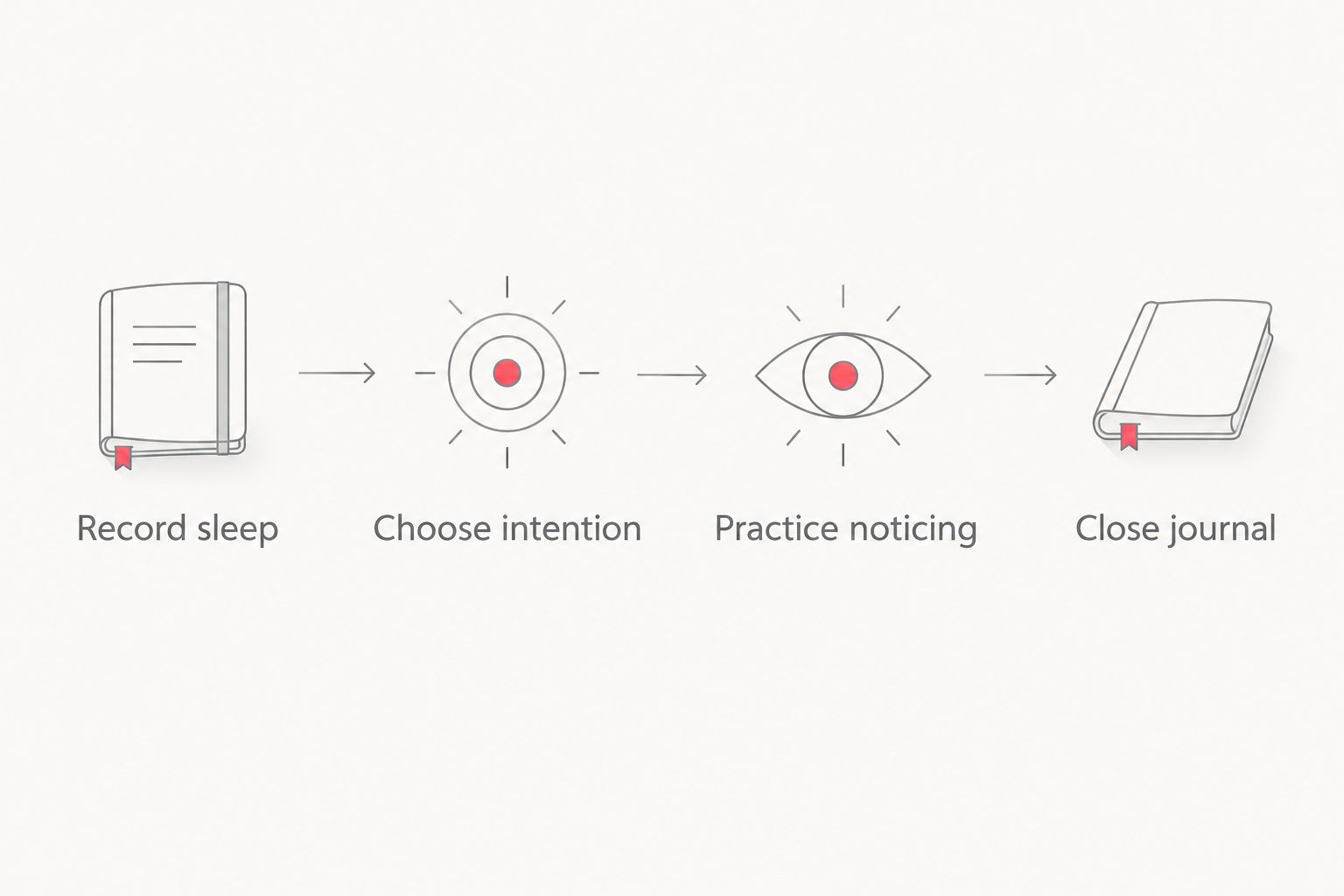
Use a repeating sequence: record the previous night in the morning, choose a manageable evening action, and end the day with present-moment attention. Review your notes away from bedtime so that looking for patterns does not become another task in bed.
1. Record sleep after waking
Write what you remember about the night. Include your approximate bedtime, when you got up, any remembered awakenings, and how rested or sleepy you feel. Estimates are enough; you do not need to reconstruct every gap.
Add context only when it helps explain something you want to understand. That might be a stressful conversation, an unusual work schedule, an evening drink, or time spent scrolling. Describe what happened without declaring it the cause of your sleep.
2. Choose an evening intention
Read your notes earlier in the day, then choose an action within your control. You might put your phone aside before your wind-down, leave tomorrow's tasks on paper, or make room for quiet reading.
Write the intention as an action, not an outcome. Replace “fall asleep easily” with “stop checking work messages during my wind-down.” You can choose the action; you cannot order sleep to arrive.
3. Practice noticing before bed
Sit somewhere comfortable and notice an ordinary sensation: your feet on the floor, your hands resting, or sounds in the room. Let breathing happen naturally. When a thought appears, acknowledge it and return to the sensation you chose.
You do not need to clear your mind. Noticing that you are planning tomorrow is already an act of attention, not evidence that the practice failed.
4. Close the journal
If you want an evening entry, write a short observation about what you noticed. “My shoulders felt tense, and I kept thinking about work” is enough. You do not need an explanation, a solution, or a positive ending.
Then close the notebook. The end of the practice is putting it down, not reaching a particular feeling.
When should you write and when should you practice?
Best for a clear separation: morning sleep notes and an evening mindfulness check-in. This arrangement keeps recollection separate from settling down. You can still adjust it around your work, caregiving, or sleep schedule.
| Arrangement | Best for | Advantage | Limitation |
|---|---|---|---|
| Morning journal, evening mindfulness | Keeping observation separate from bedtime | Gives each activity a distinct purpose | Requires returning to the routine at different points in your day |
| Journal and mindfulness earlier in the evening | People who become alert when writing | Keeps reflection away from the bed | The journal still needs a later morning entry for that night's sleep |
| Brief evening note after mindfulness | People who want to capture an observation | Connects awareness with a simple written record | Can turn into analysis if you keep expanding the entry |
Choose by what the activity does to your attention. If evening writing leads to planning, move it earlier. If mindfulness becomes an effort to force sleep, choose a neutral sensory anchor and drop the demand to feel calm.
Avoid filling in the journal during nighttime awakenings. Leave the record until morning rather than making each awakening a reporting task.
A reusable sleep and mindfulness journal template for 2026
Use this layout in a notebook or on a plain sheet of paper. The prompts are a suggested structure, not a clinical assessment. Leave out any field that encourages repeated checking rather than useful observation.
Morning: what happened?
- Date: Include 2026 so entries remain clear when you return to them later.
- Sleep timing: Approximate bedtime and time you got up.
- Nighttime memory: Anything you remember about waking or difficulty settling.
- Morning state: How rested, sleepy, tense, or alert you feel.
- Relevant context: An unusual event or change in your routine.
Keep observation separate from interpretation. “I answered messages before bed and remember being awake for a while” describes a night. “Messages ruined my sleep” claims a cause that the entry alone cannot establish.
Evening: what is here now?
- Body: What physical sensation do you notice?
- Mind: What thought or concern keeps returning?
- Response: Can you acknowledge it without solving it right now?
- Intention: What simple action will you take before putting the journal away?
You can answer in fragments. A tired evening does not need polished prose, a gratitude list, or a lesson. If words are not helpful, skip the entry and notice the contact between your body and the chair.
Keep planning on a different page
A task list serves a different purpose from a sleep record. If a practical concern needs attention, write the task separately so you can find it tomorrow. You do not need to finish planning before you are allowed to rest.
Close both pages when you are done. Reopening the notebook to improve the entry turns a stopping point into another round of work.
Why your combined routine needs to vary
The useful version is the one that fits your actual day. A demanding routine can become another obligation, even when every activity sounds restful on its own.
- Your schedule: Base morning notes on when you wake from your main sleep, not on a conventional office timetable.
- Your response to writing: Keep reflection earlier if it makes you alert or pulls you into problem-solving.
- Your attention anchor: Use sound or physical contact if focusing on breathing feels uncomfortable.
- Your reason for tracking: Record details that answer a useful question rather than collecting everything you can remember.
- Your current capacity: Shorten or skip an entry when the routine feels burdensome. Do not create a backlog to repay.
For your 2026 routine, choose the simplest version first. Add a prompt only when it serves a clear purpose. More fields do not automatically make a journal more useful.
How do you review entries without judging yourself?
Read your notes at a separate time from your wind-down. Look for recurring observations and questions, not a score for how well you behaved. An entry can tell you what happened without telling you why.
Ask what changed across several entries. Perhaps late work appears repeatedly, or you notice that long evening reflections keep becoming task lists. Treat that as a reason to adjust an action, not as proof of a diagnosis or a personal failure.
Choose a change you can describe plainly. “I will leave work messages until morning” is clearer than “I will improve my sleep habits.” Keep the rest of the routine familiar so you can understand what you actually changed.
Do not grade mindfulness by the sleep that follows it. You can practice noticing with care and still have a difficult night. Your next entry should record that night honestly, without turning it into a verdict on your effort.
What if mindfulness makes me more aware of worries?
Mindfulness does not require you to make worries disappear. If attention to thoughts becomes overwhelming, shift toward something external, such as sounds in the room, and keep your eyes open if that feels better.
You can also stop. A bedtime routine is not an endurance exercise, and continuing through distress is not a requirement. Seek professional guidance if the practice repeatedly feels upsetting or difficult to manage.
Can I use a printable journal instead of an app?
A printable journal works if you prefer handwriting and want the routine away from your phone. Paper also means you will review entries manually and keep the pages somewhere private. Choose the format you will use without repeatedly checking it.
Social Hideouts is best for people who want printable sleep and mindfulness guides. Its PDF format fits a paper-based routine; the trade-off is handling your own printing and written records. A guide supports reflection, but it does not replace assessment or treatment for a sleep problem.
What should I do after a difficult night?
Write a plain account after waking, then leave the entry alone. You do not need to identify a mistake, compensate with a longer meditation, or redesign your whole evening because of a difficult night.
Return to the manageable parts of your routine. If sleep problems persist, affect your daily functioning, or involve symptoms such as gasping during sleep, speak with a healthcare professional. A journal can help you describe your experience; it cannot determine the cause.
FAQ
What's the easiest way to combine a sleep journal and mindfulness practice?
Record sleep after waking and practice mindful attention before bed. Keep morning notes factual, and finish the evening practice without requiring yourself to feel calm or sleepy.
Should I write in my sleep journal before bed or in the morning?
Write the sleep record in the morning, after the night it describes. An optional evening note can capture what you notice now, but it should not become a detailed analysis or task-planning session.
How long should I meditate before writing in a sleep journal?
You do not need a fixed duration to connect mindfulness with journaling. Notice an ordinary sensation, acknowledge distractions, and write only if recording the experience feels useful rather than demanding.
Can I use the same notebook for sleep tracking and mindfulness?
Yes, you can use the same notebook for sleep tracking and mindfulness. Label morning observations and evening reflections separately so that a factual sleep record does not become mixed with predictions or self-criticism.
What should I include in my 2026 sleep journal?
Include the date, approximate sleep timing, remembered awakenings, your morning state, and relevant context in your 2026 sleep journal. Leave out fields that lead you to check repeatedly or reconstruct details you do not remember.
Is a printable sleep journal better than an app?
A printable sleep journal is the better fit when you want a paper-based routine away from your phone. Socialhideouts offers printable PDF guides and templates for sleep and mindfulness; paper requires manual review and a private place to store entries.
Will sleep journaling and mindfulness cure insomnia?
Sleep journaling and mindfulness are not a guaranteed cure for insomnia. Persistent sleep difficulties or daytime impairment need professional assessment; bring your notes if they help you explain what you have been experiencing.
One last thing
Write a stopping instruction inside the cover of your 2026 journal: Close the notebook even if the night still feels unfinished. This is a practical boundary, not another standard to meet. There will always be another thought you could record.
A printable guide from Social Hideouts can give your notes a place to go. It does not need to become a project. Leave room for an ordinary evening, an imperfect night, and a morning when you begin again.